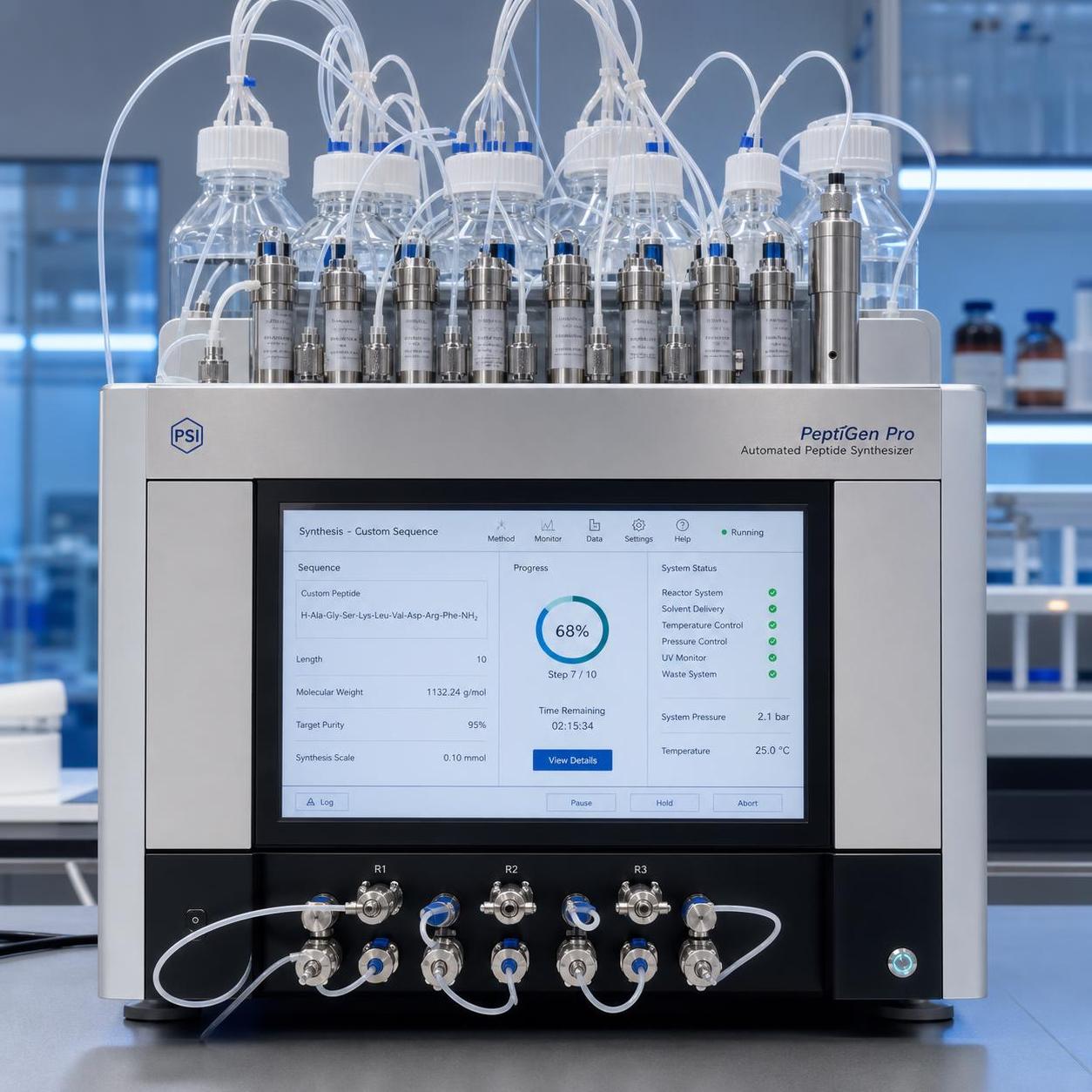
In life sciences, immunology, and pharmacological mechanism research, institutions frequently require custom peptides with highly specific structures and complex sequences. Synthesizing these high-difficulty peptides—such as those featuring dense hydrophobic amino acid regions, multiple disulfide bonds, phosphorylation modifications, or exceptionally long peptide chains—poses immense chemical synthesis challenges. As the mainstream methodology, the procedural execution of Solid-Phase Peptide Synthesis (SPPS) directly dictates the success or failure of custom synthesis. Faced with a crowded online marketplace of suppliers, how can research laboratories and academic institutions objectively evaluate the genuine SPPS capabilities of a "peptide factory" from a technical and engineering standpoint? The following three structural dimensions serve as critical evaluation benchmarks:
1. Automation Levels and Technical Competency in Core Synthesis Workflows
The synthesis of high-difficulty sequences is exceptionally prone to steric hindrance and incomplete coupling. Premier manufacturing-based peptide factories do not rely solely on manual procedures; instead, they integrate advanced modern technology matrices.
◾ Advanced Equipment Assets: Evaluate whether the factory is equipped with multi-channel automated solid-phase peptide synthesizers and Microwave-Assisted SPPS (Solid-Phase Peptide Synthesis) units. Microwave-assisted technologies effectively disrupt peptide chain aggregation, drastically boosting coupling efficiency for high-difficulty hydrophobic segments.
◾ Specialized Modification Capabilities: Inquire about the factory's historical success rates regarding cyclization (such as head-to-tail or side-chain cyclization), isotopic labeling, fluorescent tagging (e.g., FITC), and the precise, directional formation of multiple disulfide bonds. Facilities that regularly overcome these technical bottlenecks demonstrate a profound mastery of organic synthesis chemistry.
2. Purification Workshops and Engineering Thresholds for Complex Matrix Resolution
In solid-phase synthesis, generating a "crude peptide" is relatively straightforward; the true technological watershed lies in "purification." High-difficulty long-chain peptides yield numerous structural analogs, deletion peptides, and closely related byproducts during synthesis.
◾ Industrial-Scale Separation Systems: Excellent peptide factories house high-performance preparative liquid chromatography (Prep-HPLC) purification complexes spanning analytical to industrial scales, and utilize orthogonal stationary phases across multiple purification rounds.
◾ Purity Baselines: Assess their ability to consistently deliver specified purities of 95% or even 98%+, alongside endotoxin thresholds tightly controlled within research-mandated parameters. Only factories with highly refined purification engineering can guarantee that your scientific data remains uncompromised by trace impurities.
3. Academic Resonance and Synthesis Route Evaluation Responsiveness
Custom research peptides are highly bespoke projects that lack standardized, universal protocols. Trading brokers or lower-tier workshops often take several days to consult external freelancers upon receiving a complex sequence—or worse, accept the order blindly only to face repeated synthesis failures.
A mature peptide factory employs an in-house expert team consisting of organic chemistry PhDs, molecular biologists, and veteran synthesis engineers. Upon receiving a sequence from a research lab, they can complete a comprehensive Synthetic Route Evaluation within 24 to 48 hours, accurately identifying potential aggregation nodes and proactively proposing rational synthetic alternatives (such as utilizing pseudoproline dipeptide derivatives). This highly efficient and professional academic resonance is the ultimate touchstone of a genuine, technology-driven source factory.
Conclusion
For research institutions pursuing rigorous and reproducible scientific data, selecting a peptide manufacturing partner is never a matter of basic price comparison. It requires a comprehensive audit of solid-phase synthesis infrastructure, microwave capabilities, chromatographic purification, and strategic route design. By verifying a factory's instrumentation assets, specialized modification repertoire, and technical response times, researchers can precisely secure a highly qualified peptide factory—establishing a solid, compliant chemical foundation for pioneering scientific exploration.
Our Product
Online Message
Online Message

Thank you very much for writing to us. Please leave your message and contact information, we will reply to you within 24 hours.