In the premium cosmetic and dermatological ingredient marketplace, Copper Peptide (frequently cataloged within the supply chain as CU Peptide or GHK-Cu) has long occupied a central position due to its unique, natural sky-blue hue and outstanding biological activity. However, for global procurers, Copper Peptide is also notoriously fragile. In large-scale commercial manufacturing, premier source peptide factories invariably allocate a significant portion of their R&D budget to one core objective—the anti-oxidation and stabilization technology of the peptide. The core chemical engineering logic behind this practice directly dictates the final quality of the formulation:
1. Overcoming the Natural Vulnerability of Copper Ion Dissociation and Unstable Coordination
From a structural chemistry perspective, Copper Peptide is a complex formed by the non-covalent chelation of Tripeptide-1 (GHK) with a divalent copper ion ($Cu^{2+}$). While this coordinated structure exhibits a beautiful aquatic blue color under ideal conditions, it dissociates easily when exposed to aqueous solutions, elevated temperatures, or fluctuations in pH.
Once chelation fails, the free divalent copper ions split from the peptide chain. This not only causes the raw material to shift from its signature "pure blue" to yellow, green, or lose color entirely, but also strips away its intended biological activity. By utilizing proprietary solid-phase synthesis and crystallization control techniques, advanced peptide factories optimize the molecular configuration during initial synthesis. This substantially reinforces the binding strength between the copper ion and the peptide backbone, locking the material's stability at both physical and chemical levels.
2. Resolving Technical Bottlenecks of Rapid Oxidative Degradation
As short chains composed of amino acids, peptides are naturally prone to self-oxidation and degradation when exposed to air, light, or trace levels of oxygen.
◾ Discoloration and Precipitation: Copper Peptide is exceptionally sensitive to light, heat, and oxygen. Low-tier or workshop-style facilities produce peptide powders that oxidize rapidly during transit or storage, resulting in sharp drops in purity, off-odors, and precipitation.
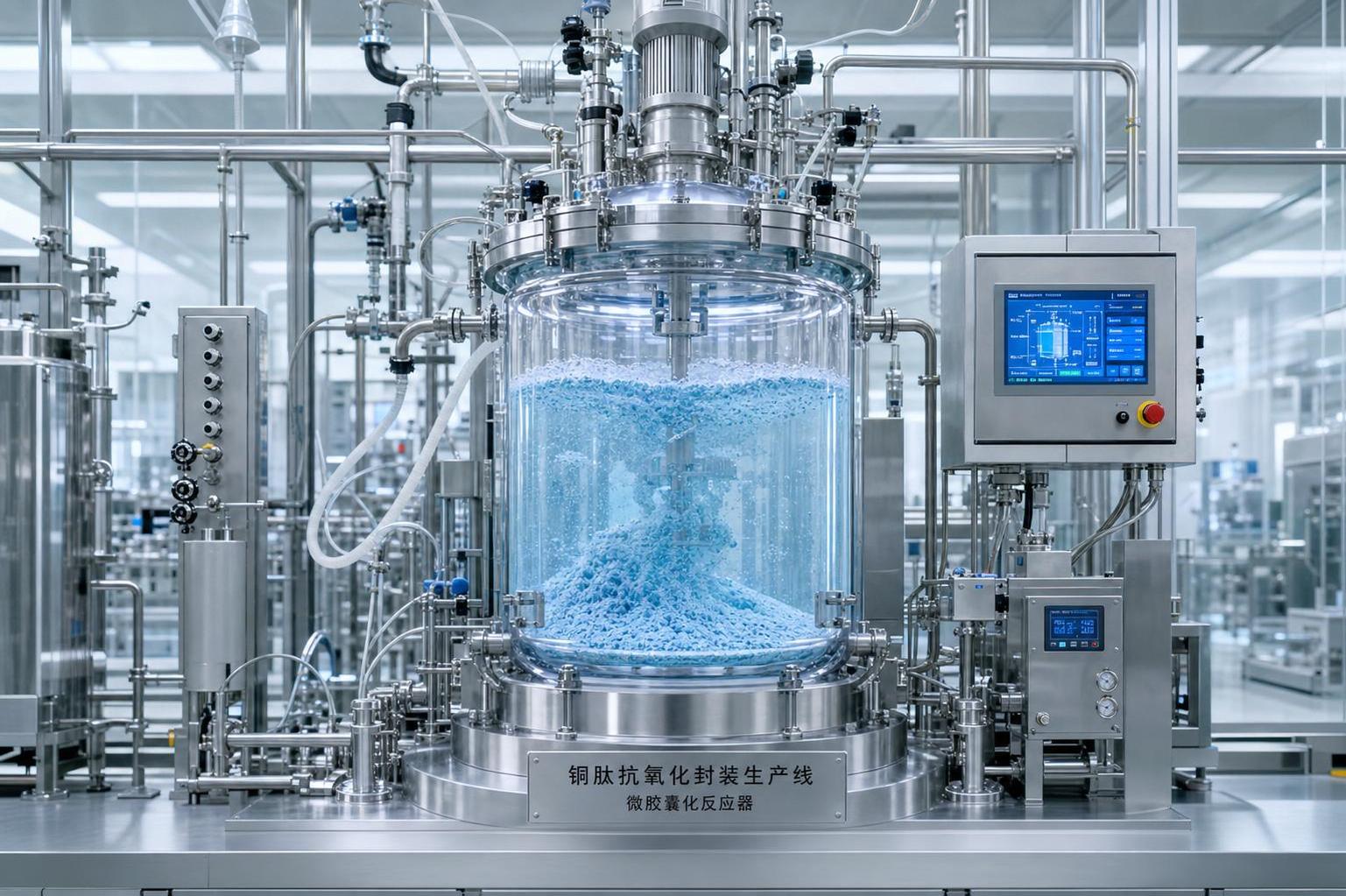
◾ Industrial-Grade Anti-Oxidative Encapsulation: Leading peptide factories introduce cutting-edge anti-oxidation protocols during the purification and freeze-drying phases. For instance, they optimize crystal structures in vacuum, oxygen-free environments, or deploy microencapsulation technologies to provide a nano-scale "protective jacket" around the Copper Peptide molecules. This shield blocks external oxygen and UV interference, ensuring the peptide retains an industrial-grade purity of 99%+ throughout long-distance cross-border shipping and extended storage.
3. Maximizing Raw Material Compatibility in Downstream Formulations
Within the B2B supply chain, a peptide factory's clients are predominantly cosmetic brands or OEM/ODM contract manufacturers. In downstream skincare formulations, standard Copper Peptide is notoriously difficult to formulate—it reacts readily with chelating agents, thickeners (such as carbomers), plant extracts, or Vitamin C, causing the emulsion to separate, change color, or fail.
Excellent modern peptide factories approach raw material synthesis with an "application-end mindset." By adjusting the counter-ion type (such as acetate forms) of the peptide and strictly controlling the ratio of trace free copper during manufacturing, factories produce Copper Peptide raw materials that exhibit exceptional tolerance within targeted pH ranges. This technological stabilization significantly lowers the R&D hurdle for downstream chemists, preventing large-scale product recalls caused by ingredient instability.
Conclusion
For large-scale peptide factories, simply synthesizing Copper Peptide is not the ultimate challenge; the true test lies in maintaining its active state across complex global logistics and downstream formulations. Consequently, the true touchstone of a "peptide factory's" technical capability is its underlying anti-oxidation and stabilization craftsmanship. Through these precise technological barriers, source factories do not just deliver high-purity ingredients—they build a fortified quality moat for the supply chains of global brands.
Our Product
Online Message
Online Message
Thank you very much for writing to us. Please leave your message and contact information, we will reply to you within 24 hours.